Introduction
When a sudden downturn hits, lay offs can be a lifeline for businesses that want to avoid permanent redundancies. However, navigating the legal requirements when laying off staff requires careful planning and a clear understanding of employment law. As an HR consultancy advising SMEs with 10–50 staff, we recently guided a high-end garden furniture manufacturer through a challenging period. This case study examines how we helped them implement temporary lay offs while protecting both the business and its employees.
The Background: A Crisis Unfolds
Our client, a manufacturer of premium garden furniture, employed 12 workshop staff and relied on a single high-end retailer for over 85% of their order book. When that retailer suddenly cancelled all summer orders—citing competition from online retailers—the business faced a crisis. There was insufficient work for the workshop team and no prospect of new orders for at least eight weeks.
The employer was determined to avoid making staff redundant. They had a plan to find new orders to fill the gap, but this would take weeks. They also feared that if they let staff go, they would be unable to fulfil any new orders they secured. The solution? To temporarily lay the workshop staff off.
The Challenge: Avoiding Redundancy Claims
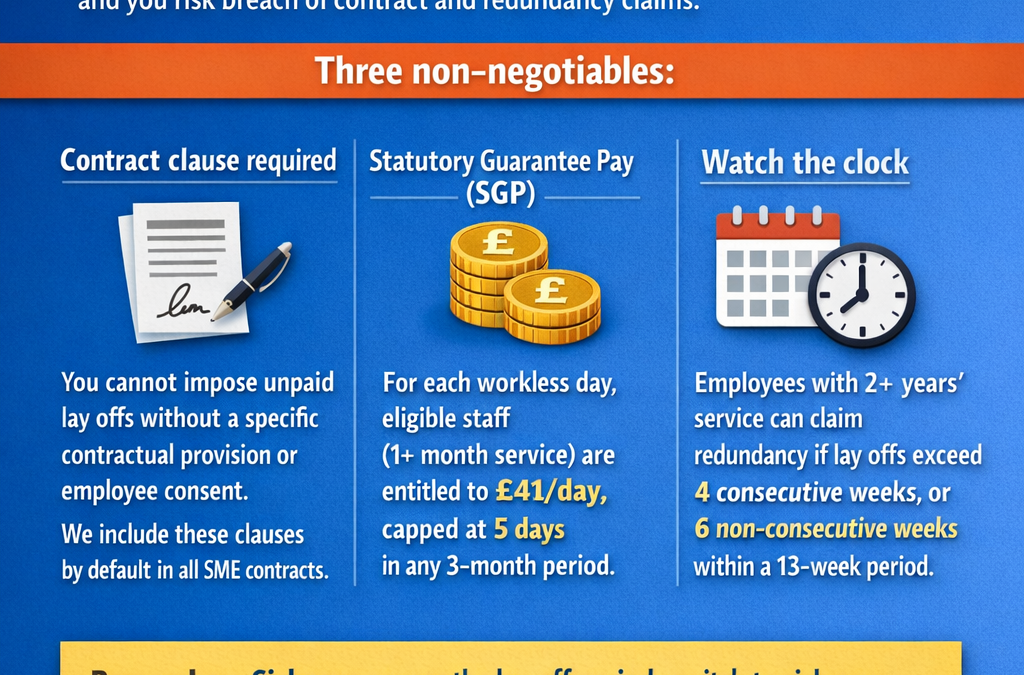
The employer’s primary concern was that by laying off staff they could inadvertently give employees the right to claim redundancy pay. Under UK law, employees can claim a redundancy payment from you if they are laid off for four or more weeks in a row, or six or more weeks in a 13-week period where no more than three are consecutive. To qualify, they must have at least two years’ continuous service.
Furthermore, there is no statutory right for employers to impose lay offs. Such action can only be taken if the employee agrees to it, or if it is provided for in the contract of employment. In the absence of a contractual term, laying employees off without pay would be a breach of their contracts.
Our Approach to lay offs: A Contractual Solution
Fortunately, all 12 staff had lay offs clauses in their contracts—we include these clauses in terms and conditions by default. This gave the employer the legal footing needed to proceed. Our advice was clear: to avoid triggering redundancy rights, the lay offs could not exceed the statutory limits.
Structuring the Lay Offs
We devised a rota system that would allow the business to retain all staff while keeping everyone within the legal boundaries for laying off employees . We created four groups of three employees:
- Week 1: Group 1 works and receives statutory guarantee pay (SGP). Groups 2, 3 and 4 are laid off.
- Week 2: Group 2 works and receives SGP. Groups 1, 3 and 4 are laid off.
- Week 3: Group 3 works and receives SGP. Groups 1, 2 and 4 are laid off.
- Week 4: Group 4 works and receives SGP. Groups 1, 2 and 3 are laid off.
From week 5, the cycle would continue, but statutory guarantee pay would no longer be payable. This pattern would continue for three cycles (12 weeks), at which point the employer would decide whether redundancies were necessary or if normal operations could resume.
Statutory Guarantee Pay: What Employees Are Entitled To During Lay Offs
During lay offs, employees are entitled to statutory guarantee pay (SGP) for days they would normally have worked but were not provided with work. The current rate is £41 per day, payable for a maximum of five workless days in any three-month period. Employees must have been employed continuously for at least one month to qualify.
We ensured all correspondence clearly explained that during lay offs, employees would receive SGP for their designated working week, and that this was not a dismissal. We also reminded them that they must continue to make themselves available for work and be ready to return immediately if requested.
Managing Sickness During Lay Offs
We also advised the employer on how to handle sickness during lay offs. If an employee is sick, the lay-off period is paused, and normal absence management procedures apply. The employee receives contractual or statutory sick pay instead of SGP, and the time does not count towards the lay offs period for redundancy pay purposes.
Documentation and Communication
We drafted all lay-off letters for each employee, outlining:
- The lay offs framework and rota system
- Entitlement to statutory guarantee pay
- Confirmation that this was not a dismissal
- The requirement to remain available for work
- Information about claiming benefits while laid off
Clear communication was essential to maintain trust and morale during this difficult period.
Key Takeaways for Employers
This case study highlights several critical lessons for businesses considering lay offs:
- Contractual clauses are essential. Without a specific clause in the employment contract allowing lay offs, employers cannot impose them without employee agreement.
- Monitor the clock carefully. To avoid employees gaining the right to claim redundancy pay, ensure lay offs do not exceed four consecutive weeks or six non-consecutive weeks in a 13-week period.
- Statutory guarantee pay is a legal requirement. Employees are entitled to SGP for workless days, capped at £41 per day for five days in any three-month period.
- Keep employees informed. Clear, written communication about the lay offs process helps manage expectations and reduces the risk of disputes.
Conclusion
By implementing a structured rota system and relying on contractual lay offs clauses, our client successfully navigated an eight-week downturn without making redundancies. The business retained its skilled workforce and was ready to ramp up production when new orders eventually arrived. For any SME facing a temporary downturn, lay offs can be an effective tool—provided the legal requirements are fully understood and followed.