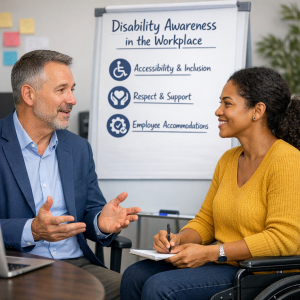
 Disability awareness at work rests on two things. First, employers need to understand how barriers disable people. Second, they need to know what the law expects of them. In this co-written post, Bee Innes of HealthyBe explains the social model of disability. Sean McCann of People Based Solutions then sets out what the Equality Act 2010 requires.
We are publishing it ahead of International Day of Persons with Disabilities on 3 December. It is a timely prompt for any employer to check how well they support disabled colleagues.
Disability awareness at work starts with the social model
By Bee Innes, HealthyBe
When I was 24, a virus left me virtually unable to leave my bed for eight years. This was made even harder by the barriers I encountered because of my physical impairment: inaccessible services, rigid systems and having to prove, again and again, that I was unwell. It was years before I came across the social model of disability, and it changed how I understood all of it.
The “medical” or “deficit” model asks, “What’s wrong with the person?” The social model asks a different question: “What barriers is this person experiencing and how can they be removed?”
In other words, the social model of disability explains how people are disabled by barriers in society, not by their impairment. When people think about accessibility, they immediately think about ramps. That matters, of course. No amount of positivity is going to turn a set of stairs into a ramp for a wheelchair user. However, only 5% of disabled people are wheelchair users.
So what about the many other forms that barriers can take? Think of an open-plan office that is too noisy to concentrate in, or information that is only available as a dense PDF. Think of a rigid start time for someone managing fatigue, or a manager’s assumptions about what a person can do. Change the barrier, and the person can take part on an equal footing.
The social model moves responsibility for exclusion onto the environments, systems and attitudes around the person with the impairment.
Usually, you can change all of these with some thought and the right culture. That is where good disability awareness at work begins.
Disability awareness at work: impairment vs disability
Simply put, an impairment is a physical, sensory, mental or cognitive difference, such as chronic pain, sight loss, depression or neurodivergence. Disability is the experience of the barriers that people with impairments face. Remove the barriers and you remove the disability, even if the impairment remains.
Five types of workplace barrier
Workplace barriers usually fall into five areas:
- Attitudinal: assumptions and stereotypes
- Environmental: lighting, noise, technology and layout
- Institutional: rigid policies and recruitment processes
- Information and communication: unclear or inaccessible formats
- Intersectional: overlapping barriers linked to race, gender, age or class
Disability awareness at work and the law: what employers must do
By Sean McCann, People Based Solutions
Many employers picture a disabled colleague as someone with a visible impairment. In practice, many of the people who qualify as disabled under the law have conditions you would never spot across an office or a shop floor.
The numbers make the point. In 2024, 5.6 million disabled people were in work in the UK. Around 1 in 5 people in the UK have a mental health impairment, and 80% of disabled people have a hidden impairment. Many do not tell their employer. Others would never describe themselves as disabled, yet their symptoms or diagnosis may still create a legal duty for an employer under the Equality Act 2010. So disabled people are already in your teams, whether they have told you or not.
Disability awareness at work and the Equality Act 2010
Under the Act, a person is disabled if they have a physical or mental impairment that has a substantial and long-term adverse effect on their ability to carry out normal day-to-day activities. “Substantial” means more than minor or trivial. “Long-term” means it has lasted, or is likely to last, at least 12 months, or is likely to recur.
The definition is not a list of conditions. Depending on their effects, fluctuating conditions such as Crohn’s disease, ulcerative colitis, chronic fatigue or depression can all qualify. The Act covers cancer, HIV and multiple sclerosis from the point of diagnosis. Menopause is not a disability in itself. However, where symptoms have a substantial and long-term effect, they can meet the definition.
Your duty of care and the duty to make reasonable adjustments
Employers have a general duty of care for employee health and safety. The Equality Act adds a specific duty. Where a provision, criterion, practice or physical feature puts a disabled employee at a substantial disadvantage, you must take reasonable steps to remove it.
Reasonable adjustments might include flexible hours, easier access to toilet facilities, a phased return to work, or changes to how absence triggers and targets are applied. Many cost little or nothing. What is “reasonable” depends on the cost, the practicality and the size of your business. Support such as the government’s Access to Work scheme may also help with the cost.
Failing to make adjustments can amount to discrimination. Furthermore, an employment tribunal does not cap compensation for discrimination.
The hidden disability trap
Disability awareness at work means not waiting for employees to tell you. The duty applies if you know, or should reasonably know, that someone is disabled.
Repeated short absences, a change in performance or an employee who seems anxious about everyday routines may all be signals to start a supportive conversation. Handle that conversation with care, keep what you learn confidential and record the adjustments you agree.
Where to start with disability awareness at work
- Review your absence and capability policies for anything that could disadvantage a disabled employee.
- Train managers to spot the signs and to have sensitive conversations.
- Make it easy for staff to ask for support without fear of stigma.
- Ask people what they need rather than assuming, and check in regularly, because needs change.
Disability awareness at work: bringing HR and health expertise together
Good disability awareness at work usually takes two things: sound policies and processes, and managers who understand how health conditions affect people day to day. Neither works well on its own.
Sean McCann of People Based Solutions supports employers with the HR side, from reviewing policies to handling adjustment and absence conversations fairly and within the law.
Bee Innes of HealthyBe works on the health side. Her services include workforce health and wellbeing strategy reviews, menopause action planning and disability awareness training for managers. She also delivers staff training on health conditions that may call for workplace adjustments, with simple, evidence-based nutrition and lifestyle tips to help manage symptoms.Together, this can help reduce presenteeism and sickness absence, and help people stay in work.
If you have questions about disability awareness at work, managing employee disability or employment law, contact Sean McCann at People Based Solutions today. Call 01925 202217 or email enquiries@peoplebasedsolutions.co.uk. If you want support with workplace health and wellbeing, or disability awareness training for your managers, contact Bee Innes at HealthyBe. call 07535 270985 or e-mail info@healthybe.co.uk Together, we can help you support your people and stay on the right side of the law.